
As a part of your New Yr preparations, it’s price taking a second to reassess your key parts of focus, and which facets of digital advertising and marketing can have the largest affect in your ends in 2026.
However with a lot altering so always, it may be laborious to know what you ought to be targeted on, and what abilities you’ll want to maximise your alternatives. With this in thoughts, we’ve put collectively an outline of three key parts of focus.
These key parts are:
- AI
- Algorithms
- Augmented Actuality
These are the three parts which can be going to sway the social media and digital advertising and marketing panorama essentially the most in 2026, and if you will get them proper, you’ll be finest positioned to get essentially the most out of your efforts.
The primary submit within the sequence checked out AI, and whether or not it’s good to have AI inside your digital advertising and marketing toolkit.
This second submit seems to be at algorithms, and the way adjustments in method to algorithmic amplification might spark main strategic shifts.
Algorithmic Polarization
Right here’s the reality of it: Algorithms amplify people who find themselves keen to make divisive statements, who’re keen to say no matter they assume needs to be mentioned, no matter who is likely to be offended by such.
On one hand, taking a stand is to be applauded, as a way to get to the core of a problem, and handle underlying truths. However on the opposite, which means algorithms additionally, inadvertently most often, flip folks into a-holes, by serving to to amplify ill-informed, anger-inspiring takes, usually with little grounding in information or actuality.
The rationale the media is so indignant, the rationale society feels so divided, can largely be traced again to the assorted on-line algorithms that outline our media expertise.
That is mirrored in all of the analysis and all of the experiences that analyze social media amplification:
- In 2016, a research discovered that “excessive arousal feelings,” resembling pleasure and worry, usually drive the largest social media response, notably by way of viral sharing.
- One other research revealed in 2016 discovered that anger, worry and pleasure drive essentially the most engagement on social media, although of the three, anger has essentially the most viral potential.
- Again in 2012, a research revealed by Wharton Enterprise Faculty discovered that content material that evokes anger is more likely to be shared extra, with the quantity of anger impressed by a submit proportionately driving the virality of that remark.
The info reveals that, primarily based on measured human response, if you wish to maximize attain and response, it’s best to look to encourage anger in your viewers, or in some group, which can then “set off” these folks sufficient to remark in your updates and share your takes, thus indicating to the algorithm that that is one thing that extra folks may need to check out.
Anger and worry are the important thing drivers, together with pleasure, although the latter is probably going harder to create on a constant foundation. And as social media has turn out to be a much bigger a part of our day-to-day existence, and other people have come to depend on social platform engagement as a way of measuring their relevance and self-worth, the dopamine rush of notifications that they get from posting such has pushed increasingly more folks to turn out to be increasingly more aggressive of their takes.
You possibly can see the indications of this within the development information stemming from the implementation of engagement-based algorithms, which began on Fb again in 2013. As algorithmic sorting turned extra refined, and extra understood, phrases like “woke” started to achieve traction, references to “pretend information” and the “mainstream media,” and even anger-inducing conspiracy theories, like “flat earth” gained traction as a result of engagement that they drive in social apps.
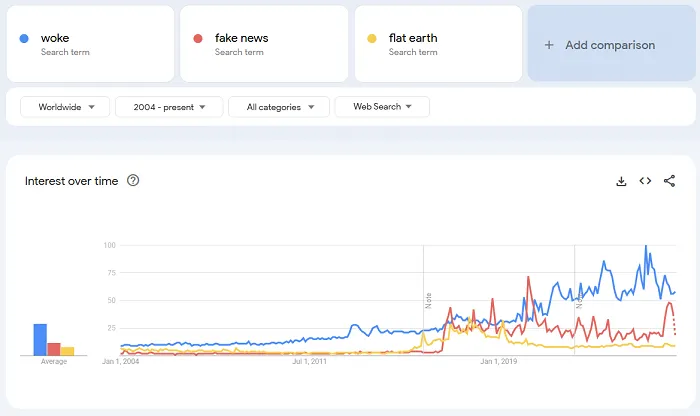
A few of this, after all, could also be correlation, however the causation argument can also’t be dominated out, and I might argue that algorithms have performed a major position within the division we’re now seeing in fashionable society, and have empowered the brand new wave of self-righteous media personalities who’ve gained big traction by saying no matter they like, underneath the guise of “free speech” or “simply asking questions,” whether or not the proof helps their view or not.
In essence, the incentives of algorithm-defined media, be it in Information Feed show or Google Search rating, have pushed creators and publishers in direction of taking extra divisive, angst-inducing stances. On all the things. Once more, profitable within the fashionable media panorama means “triggering” massive sufficient teams of individuals that you just’ll get consideration, and that usually means re-angling, or straight ignoring established information, with the intention to preserve hammering residence your most well-liked factors.
So, what does this imply for 2026?
Effectively, in 2026, folks are actually extra conscious of this, and are looking for extra methods to manage their feeds, and the content material that’s proven to them by their algorithmic leanings. Platforms are attempting out new controls that can allow folks to have extra of a say over what they’re proven in-stream, whereas AI-based techniques are additionally getting higher at understanding private relevance, right down to particular matters, and even communication types, in order that these techniques can present folks extra of what they like, and ideally, much less of what will increase their blood strain.
These new approaches received’t cease the anger fully, because the platforms themselves profit essentially the most from preserving folks commenting, and thus, by preserving folks indignant, even when in additional delicate methods. However the subsequent technology of customers is way extra conscious of such manipulation, and are higher at tuning out the b.s., in favor of extra trusted, much less polarizing, creators.
In all honesty, I don’t anticipate that many individuals are going to make use of the brand new algorithm management choices being supplied by Instagram, YouTube, X and Threads, as a result of the stats present that even when such controls can be found, most individuals merely don’t trouble to replace something.
Most customers simply wish to go browsing and let the system present them essentially the most related posts every time. TikTok has worsened this, with its omnipotent “For You” feed not even requiring any express indicators from you, it merely infers curiosity primarily based on the content material that you just watch, and/or skip.
But, even so, the truth that normal consciousness of such is rising is, total, a constructive.
Regulators are additionally exploring new methods to strain platforms to allow such management (following the lead of China), and I believe that this yr, we’re going to see extra regulatory teams smart as much as the truth that it is algorithms that trigger essentially the most harm to society, not social platforms in themselves, nor entry to such amongst younger customers.
That might assist to drive the push for algorithm opt-outs, as we’re already seeing in Europe. If folks can decide out of algorithmic sorting, that will go a great distance in direction of assuaging this manipulated strain, and whereas the platforms, once more, received’t provide such willingly, as a result of they will preserve folks utilizing their apps for longer by the usage of engagement-driving techniques, I do really feel that most people is now conscious sufficient of such that they will handle their social media feeds with out algorithmic sorting.
As a result of the unique justification for such not holds, irrespective of the way you take a look at it.
Again in 2013, Fb’s authentic explainer on the necessity for a feed algorithm outlined that:
“Each time somebody visits Information Feed there are, on common 1,500, potential tales from buddies, folks they observe and Pages for them to see, and most of the people don’t have sufficient time to see all of them. These tales embrace all the things from wedding ceremony images posted by a finest buddy, to an acquaintance checking in to a restaurant. With so many tales, there’s a good likelihood folks would miss one thing they needed to see if we displayed a steady, unranked stream of knowledge.”
Basically, as a result of folks have been following so many different folks and Pages within the app, Fb needed to introduce a rating system to make sure that folks don’t miss out on essentially the most related tales.
Which is smart, nevertheless, extra lately, Meta has truly been including in additional content material from Pages that you just don’t observe (principally within the type of Reels) with the intention to preserve driving engagement.
That might counsel that the identical content material overload concern is not an issue that Meta wants to resolve, and that customers might get a chronological feed of posts from Pages they observe, and see all of the related updates every day within the app.
Persons are additionally now extra discerning about which profiles they observe, and together, I do assume that the platforms might viably present algorithm-free choices (by default) that will be workable.
Anticipate extra regulatory teams to push for this in 2026, whereas the refinement of AI-based algorithms must also assist extra folks and pages get extra attain to folks with associated pursuits over time.
I imply, that ought to occur, except Meta restricts such with the intention to drive extra advert spend. Or perhaps to drive extra funding in Meta Verified, with Meta pushing creators to sign-up to this system to get extra attain, whereas additionally decreasing the affect of improved algorithmic attain on Meta’s backside line.
Decentralized choices can even be floated as one other various, in that they offer customers extra management over their algorithm and expertise. However the issue with decentralized instruments is identical as the difficulty in the primary apps, that including extra advanced controls turns most customers away, and other people would like the simplicity of simply letting the algorithm present them what it thinks they’ll like, versus choosing a related server and customizing their settings.
Additionally they wish to be the place their buddies are, and an algorithm opt-out, that you would be able to set because the default, is the best choice for this.
The platforms will push again, as it should possible affect utilization time, however they do even have the choice of constructing extra advanced algorithmic techniques, utilizing AI, that can higher optimize for private relevance, or assist to cut back the incentives of rage bait.
Anticipate to see extra dialogue on this to return.
Andrew Hutchinson