Regardless of varied objections to the method, and after repeatedly looking for to have its platform exempted from Australia’s coming social media entry restrictions for teenagers, YouTube is now alerting Australian customers that anybody aged beneath 16 will likely be locked out of the app on December tenth, when the brand new social media age legal guidelines come into impact.
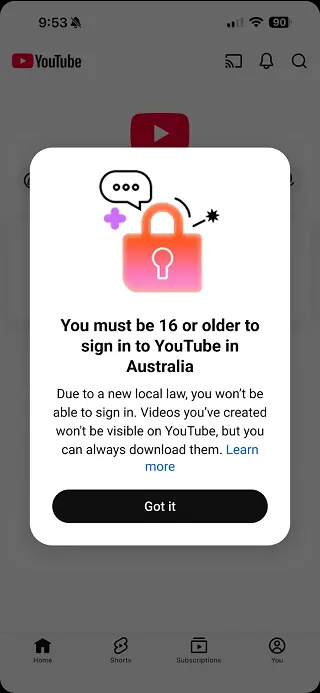
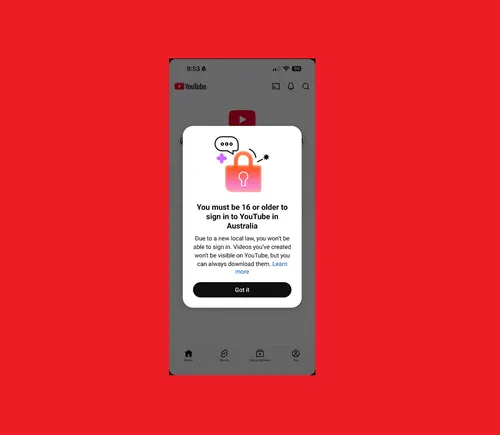
As you may see on this instance, Australian teenagers aged beneath 16 will quickly be confronted with this message after they go to log into the app, reducing them off from YouTube pending related age checks.
That can see hundreds of thousands of customers locked out of the app, although most Australian teenagers appear assured that they’ll nonetheless be capable of discover workarounds, and entry social apps by way of different means.
The Australian authorities introduced its greater social media age restrictions final yr, with YouTube initially excluded from the brand new legislation due, partly, to its academic worth. However after lobbying from Australia’s eSafety Commissioner, YouTube was re-added to the listing of restricted websites again in July, a choice that YouTube has railed towards, by highlighting its worth, in varied methods, to younger customers, whereas additionally looking for to separate itself from different social-focused apps.
However YouTube will likely be restricted beneath the brand new legislation, which can imply that the platform must implement extra stringent checks to maintain younger teenagers out of the app.
As per YouTube:
“Attributable to a brand new legislation in Australia, the minimal age required to register to YouTube in Australia is 16. Because of this beginning on 10 December 2025, customers beneath 16 years previous will likely be mechanically signed out from YouTube. This contains any supervised pre-teen and teenage accounts.”
YouTube says that signed-out customers will nonetheless be capable of view YouTube content material (that’s not age-restricted), however they gained’t be capable of like and subscribe within the app.
Youthful teenagers can even lose entry to their YouTube channels, in addition to any monetization alternatives.
YouTube says that customers can obtain their knowledge, and delete their account in the event that they select. Or they will wait to be reinstated after they flip 16, in compliance with the brand new legal guidelines.
Which, presumably, quite a lot of youthful teenagers will do, with the influence of those new restrictions more likely to have an even bigger impact on the following technology of teenagers, who’ll develop up with these new thresholds in place.
Although as YouTube has argued, the brand new legal guidelines may not have the influence that Australian regulators are hoping.
“At YouTube, we consider in defending children within the digital world, not from the digital world. That’s why we’ve invested for greater than a decade in session with youngster growth specialists to construct age-appropriate merchandise for our youngest customers, like YouTube Children, supervised experiences for teenagers and tweens, default wellbeing settings for all teenagers and strong parental controls. Because the Social Media Minimal Age Act requires children to make use of YouTube with out an account, it removes the very parental controls and security filters constructed to guard them – it is not going to make children safer on our platform.”
YouTube says that the brand new legal guidelines have stemmed from “a rushed legislative course of” which didn’t permit for enough session and consideration of the true complexities of on-line security regulation.
“The legislation additionally essentially misunderstands why teenagers come to YouTube within the first place. YouTube is a video streaming service the place they arrive to look at and study– the whole lot from ‘easy methods to tie a tie’ movies, to well-known speeches, to newsmaking podcasts, to dwell concert events, to epic sports activities highlights. And more and more, children, teenagers and households are watching YouTube on tv screens of their lounge.”
YouTube says that it’s dedicated to discovering a greater path ahead, and can proceed to work with the Australian Authorities to advocate for “efficient, evidence-based regulation that really protects children and youths, respects parental alternative, and avoids unintended penalties.”
It’s exhausting to say what’s going to occur on account of these elevated social media age limits, however the doubtless consequence will likely be that teenagers will both discover workarounds to maintain accessing these apps (I’m in Australian and I’ve teenage kids, they usually appear assured that this would be the case), or they’ll migrate to different apps and areas as a substitute.
Certainly, studies have steered that Australian teenagers are already shifting to ByteDance-owned Lemon8, in addition to photo-sharing app Yope, as a substitute.
And with decentralized social media choices additionally obtainable, it does seem to be teenagers will discover a approach, however it’s also possible to guess that Australian regulators will likely be watching on, and searching for any potential gaps.
Although I keep that the most important flaw stays the dearth of an outlined age-checking course of, with every platform merely informed to do their finest, basically, to align with the brand new guidelines. That appears too imprecise for efficient prosecution, and it’ll be fascinating to see simply how exhausting it’s for teenagers to subvert these new restrictions, and the way the federal government then seeks to penalize platforms that fail to maintain children out.
Andrew Hutchinson