
I actually wish to consider that Snapchat can succeed, and present {that a} smaller participant within the social media market, which is reliant on its relationship with its viewers, can problem the larger, billionaire-backed giants within the area.
However proper now, I simply don’t see it.
In its most up-to-date earnings announcement, Snapchat reported a decline in U.S. customers, whereas additionally posting lower-than-expected income numbers.
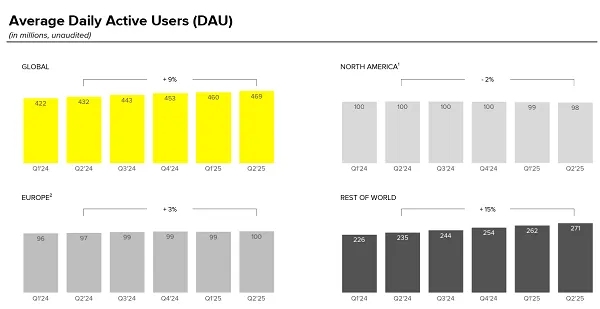
The developments right here don’t bode effectively for the app, whereas its prices additionally proceed to rise, and with Snap trying to immediately problem Apple and Meta on AR glasses as a key basis of its next-level push (with a tool that, by all accounts, is not going to be as much as the identical customary as these different choices), I don’t see the way it’s going to have the ability to enhance its margins in a big manner.
And clearly, Snapchat founder and CEO Evan Spiegel additionally shares at the very least a few of these issues.
This week, Spiegel has revealed an open letter that he despatched to Snap employees to mark the app’s 14th birthday, during which he outlines its present market place, its future alternatives, and the way he hopes to capitalize on its potential.
And on a constructive observe, Spiegel says that Snapchat is “on the verge of greatness,” although he additionally says that Snap is “in a crucible second,” which may make or break the corporate over the subsequent whereas.
And on the latter, I agree with him.
Spiegel’s massive hope is that Snap can handle prices, maximize its promoting alternatives, and reaffirm its enterprise foundations over the subsequent two years.
Spiegel’s view would see Snap attain a billion customers, and $6 billion in income by the top of 2025. Snap’s presently on monitor to usher in round $5.5 billion for the 12 months, and has 932 million month-to-month energetic customers, so this isn’t an unrealistic aim, however the problem for Snap lies in progress, and constructing on its alternatives when it appears to have plateaued in its key income markets.
So how will Snap attain the subsequent stage, and can it have the ability to construct its personal AR glasses into a big income factor?
On the income facet, Spiegel says that Snap will deal with medium-sized advertisers to generate extra curiosity, which is a market phase that Snap hasn’t but maximized. Spiegel says that Snap’s enterprise growth crew has introduced in 2,000 new activations this 12 months, and its enhancing advert choices are driving higher efficiency.
By way of particular advert alternatives and wins, Spiegel additionally notes that:
- Snapchat’s up to date app promoting choices have pushed a 25% raise in app installs, and an 18% rise in distinctive converters amongst adoptees.
- Sponsored Snaps, which insert advertisements into Snapchat person inboxes, are delivering as much as 22% extra conversions, and practically 20% decrease CPAs
- Promoted Locations have already proven double-digit visitation lifts in early testing
Snapchat+ is one other consideration right here, and Spiegel says that it’ll quickly develop its paid add-on package deal with extra options, together with live-streaming performance. Snapchat+ now has greater than 15 million subscribers, exceeding the relative efficiency of paid add-on choices of different social apps, although it additionally stays a minor a part of the platform’s broader income pie. Snapchat+ will generate over $700 million for the app this 12 months.
Together, it’s certainly attainable that these tasks will assist Snap attain its rapid income targets, however the long term concern is that if Snapchat has reached its restrict in key income markets, that can in the end cap its advertiser potential as effectively. So Snap might not have a whole lot of progress left.
Which ends up in its different alternatives, and its focus, as famous, on AR glasses, a venture that Snap’s been working in the direction of for a decade.
Snap’s Spectacles have lengthy appeared poised to make the leap into full AR performance, however complicated technical challenges have confirmed tough for all builders to beat. But, even so, Snap’s hoping to launch its first AR-enabled glasses subsequent 12 months, beating each Meta and Apple to the punch with purposeful, modern AR wearables.
Is that attainable, and whether it is, can Snap really compete with the identical from its extra resourced opponents?
As per Spiegel:
“Specs are an unlimited enterprise alternative. One pair of Specs can substitute for a lot of screens. Our working system, personalised with context and reminiscence, compounds in worth over time. A market of digital items, from spatial Lenses to digital instruments, has near-zero marginal price and world attain. Specs are how we transfer past the bounds of smartphones, past red-ocean competitors, and right into a once-in-a-generation transformation in the direction of human-centered computing.”
So Snap’s clearly hoping that AR glasses will pose an actual alternative, however primarily based on what we learn about Snap’s machine thus far, it’s tough to see how Spiegel and Co. will have the ability to capitalize on this imaginative and prescient, with higher, extra well-equipped, extra purposeful AR glasses additionally coming from a lot bigger opponents.
Principally, Snapchat’s AR glasses received’t be pretty much as good as Meta’s machine. And with Snapchat additionally restrained by prices, which it’s actively working to maintain down, I don’t see how Snap will see any actual degree of success, with what’s going to be a vastly costly venture.
And that is the actual problem, the actual “crucible second” for Snap. If its AR Spectacles aren’t an enormous success, its progress alternatives all of a sudden get very restricted. Its viewers attain is proscribed, which implies its advert enterprise can be considerably constrained, and it’s already added advertisements into the inbox.
So what subsequent? What occurs when Snap can’t do away with thousands and thousands of its AR Spectacles that nobody desires, and it could’t develop its U.S. and European audiences?
I believe that AR glasses will certainly be the crucible inflection level that Spiegel’s referring to, and that they are going to find yourself being an anchor for Snap shifting ahead.
Snap doesn’t have its personal AI infrastructure, relying as an alternative on exterior partnerships, and it doesn’t have a lot room to maneuver in shifting strategic priorities past this roadmap. If AR Spectacles fail, Snap all of a sudden turns into very confined, and when Meta’s AR glasses launch in 2027, I believe that’s precisely the place it is going to be.
Not {that a} billion customers is dangerous, nor that Snap can’t preserve a enterprise at a smaller scale. However with traders searching for fixed progress, I believe that Snap can be feeling the strain shifting ahead.
Andrew Hutchinson