
Meta has shared an replace on its efforts to align with Australia’s new teen social media ban, which places the onus on social platforms to maintain all teenagers below the age of 16 off their platforms, or face vital monetary penalties.
The brand new regulation went into impact on December tenth, and to this point, Meta says that it’s eliminated entry to nearly 550k accounts that it believes belong to underage customers.
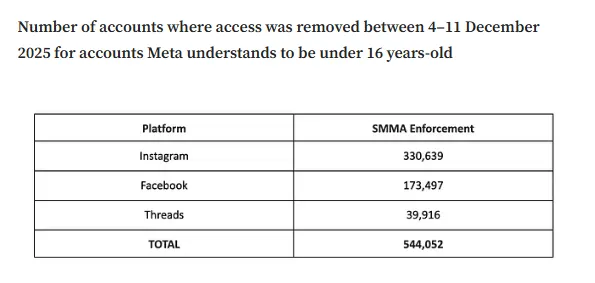
That’s lots of profiles which have seemingly misplaced entry to Fb, Instagram and Threads, although Fb and Threads are in all probability much less of a priority to most teen customers.
Instagram, nonetheless, is a key connector, with many children logging onto IG for connection and leisure. For context, Snapchat reported that it had round 440k customers aged below 16 earlier than the regulation was enacted.
The impacts there might be vital, however I can say, as a mother or father of two teenagers impacted by this alteration, that only a few younger customers appear overly involved, and don’t seem to have modified their utilization habits considerably since December tenth.
That’s as a result of they will use VPNs and different connection choices to get across the guidelines, whereas many use Instagram in logged-out kind, which nonetheless permits them to scroll via Reels, with some algorithmic refinement. It’s slightly extra restricted, however there’s been minimal change in conduct that I’ve seen or heard about, regardless of these reported numbers.
Australia’s social media regulation, which is the primary vital restriction of social media entry primarily based on age in a Western nation, goals to raised shield children from dangerous publicity on-line, by making certain that younger teenagers aren’t being proven grownup content material, or being negatively influenced by social platform algorithms.
However once more, as I’ve famous beforehand, it’s a flawed strategy, that’s simply subverted, whereas the assumptions of the regulation additionally don’t match as much as the analysis, nor the potential for hostile danger by pushing teenagers to different, much less protected areas of the online.
One of many key flaws, at the least from a authorized perspective, is that Australian authorities haven’t mandated a method to test person ages, as a way to maintain younger teenagers out of their apps. As a substitute, the Australian regulation places the onus on the platforms themselves to “take affordable steps” to limit teenagers below the age of 16 from accessing their apps.
“Cheap steps” is a reasonably imprecise qualifier, particularly while you’re threatening penalties of $50 million for violations, and if it comes right down to a authorized argument, it’s going to be troublesome for a court docket to definitively rule on “affordable steps,” particularly when you think about what, say, Elon Musk may think about “affordable” versus anyone else.
On this entrance, Meta says that it’s trying to implement AgeKeys from OpenAge, which can allow customers to arrange a verified age key, that’s then saved on their system, and permits them to share “verified age alerts” with collaborating platforms in a privacy-preserving method.
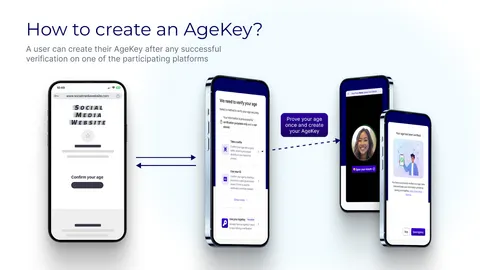
“Customers can confirm their AgeKey in a number of methods, similar to with a government-issued ID, monetary data, face estimation, or nationwide digital wallets. Meta will start to combine this software into its apps in Australia and different markets in 2026.”
That may then present one other barrier for entry, although the true worth of such is basically primarily based on broader adoption, and making it as simple as potential for younger customers to make use of AgeKeys to show their age.
Which is why Meta continues to push for laws round age verification and parental approval on the app retailer degree.
“To make sure all teenagers are protected on-line, we imagine laws ought to require app shops to confirm age and procure parental approval earlier than their teenagers below 16 can obtain an app. That is the one technique to assure constant, industry-wide protections for younger folks, regardless of which apps they use, and to keep away from the whack-a-mole impact of catching up with new apps that teenagers will migrate to as a way to circumvent the social media ban regulation.”
On this, I agree, with the app shops having a lot broader oversight, via the obtain bottleneck, that may assist to make sure higher enforcement of the principles.
Nevertheless it looks like that’s a harder case to crack, or that politicians are extra eager to make a public stance towards social media corporations, that are seen because the unhealthy guys amongst voters.
In any occasion, Meta is working to implement higher age-checking programs, however they’ll stay inclined, which is necessary to notice as extra areas think about related restrictions.
Andrew Hutchinson