Meta’s trying to assist older customers keep away from on-line scams, as a result of everyone knows that it’s older internet customers who all the time fall for the newest Nigerian inheritance, Amazon customized service, Fb password scams.
And earlier than you get riled up, previous timer, that’s not an opinion, that is established reality.
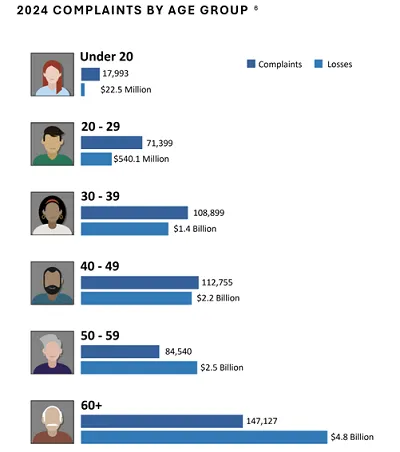
In response to the FBI’s Web Crime Report, web customers over the age of 60 submitted essentially the most complaints, and suffered essentially the most losses in 2024, with a mixed $4.8 billion misplaced to scams on this age group alone.
On-line scams are a large drawback, and information gaps are a key vector that allow these schemers function. As such, Meta’s trying to present new prompts to alert older customers to potential scams, whereas it’s additionally shared some recommendation which you can cross on to you uncles and aunts who spend an excessive amount of of their time scrolling by Fb.
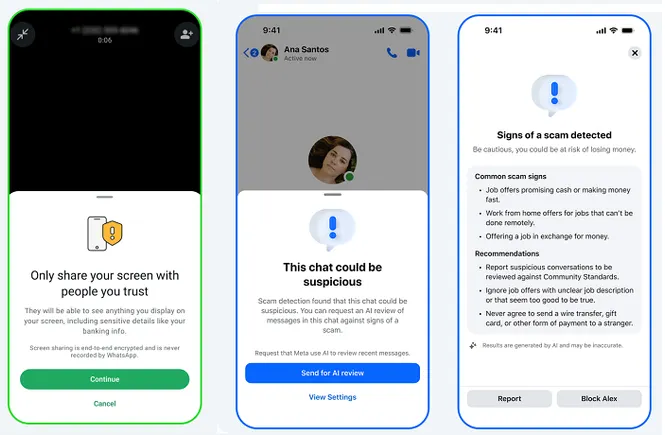
First off, Meta’s including new warnings on WhatsApp and Messenger that can alert customers to frequent scams.
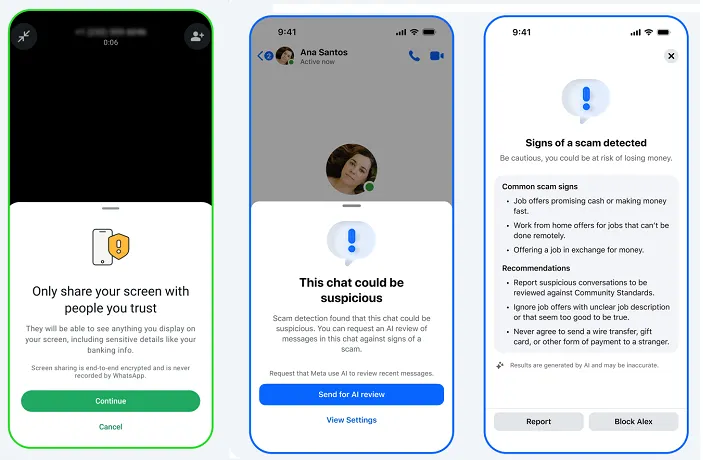
As you’ll be able to see in these instance screens, on WhatsApp, Meta’s including warnings about display sharing, and the potential vulnerabilities of enabling such, whereas on Messenger, it’s testing extra superior rip-off detection in chats.
As per Meta:
“When that is enabled and a brand new contact sends a probably scammy message, we warn you and offer you an choice to ship latest chat messages for AI rip-off overview. If a possible rip-off is detected, you’ll get extra data on frequent scams, and we are going to recommend actions together with blocking or reporting the suspicious account.”
That’ll assist to spotlight frequent rip-off vectors, and lift consciousness of potential vulnerabilities which can be recurrently exploited by such schemes.
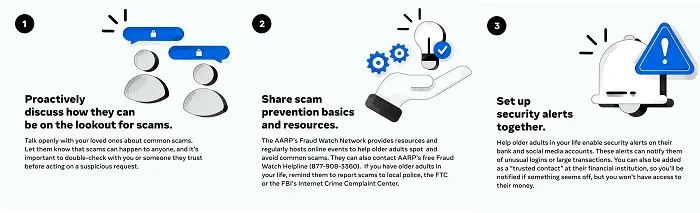
Meta’s additionally shared some recommendations on how one can assist your family members keep away from potential scams on-line:
Whereas Meta’s additionally outlined some frequent scams that older customers are inclined to go for, to assist increase consciousness of what to look at:
- Pretend house transforming providers and debt reduction: Scammers created web sites designed to solicit private data beneath the pretense of offering fictitious authorities advantages for senior residents, together with debt reduction and low- or no-cost house renovations. They tried to drive folks to those web sites utilizing on-line advertisements, together with on Fb and Google.
- Fraudulent cash restoration providers: Scammers created web sites impersonating the FBI’s Web Crime Grievance Heart’s (IC3) official website beneath the pretense of serving to folks get well funds, together with from crypto scams. In addition they ran inauthentic accounts throughout many providers, together with Fb, Instagram, Telegram, Threads, TikTok, YouTube, and X, posing as officers who may help fraud victims get well their cash.
- Pretend customer support help: Scammers created on-line accounts and Fb Pages posing as customer support representatives for airways, journey businesses, banks, and others. They responded to feedback beneath the official manufacturers’ posts in an try to redirect folks to DMs or Google Varieties beneath the pretense of processing the refund.
Some useful pointers, which might provide help to educate the elders in your life about frequent issues, whereas Meta’s additionally becoming a member of the Nationwide Elder Fraud Coordination Heart (NEFCC), a nonprofit that brings collectively regulation enforcement, and corporations like AARP, Amazon, Capital One, Google, Microsoft, and Walmart to fight fraud focusing on older adults.
“We will probably be working alongside NEFCC members to fight fraud on the native, state, and nationwide ranges, centered on defending older adults by sharing assets and supporting investigations into large-scale fraud operations.”
Meta additionally undertakes common critiques of rip-off networks, and has participated in numerous initiatives aimed toward addressing rip-off exercise, together with romance scams, in its apps.
These are good initiatives, and a few good pointers to assist educate all customers, not simply the oldies, about potential dangers on-line.
But, on the identical time, it’s attention-grabbing to notice the contradiction, as Meta can also be pushing folks to submit AI-generated pictures at each flip, which is one other vector that may result in confusion.
Go on Fb proper now and also you’ll be capable of discover a heap of clearly AI-generated posts which have garnered hundreds of likes, with scammers utilizing this as a way to extend their distribution, and probably amplify their scams, or unload these Pages.
That’s a rising aspect of issues, and it’s attention-grabbing that Meta’s all about saving previous folks from themselves on one hand, but it’s encouraging using a rising instrument that permits the identical on one other.
However Meta needs to be the AI firm, and clearly, business pursuits are on an identical bar as defending customers.
Both means, these are some good tricks to cross on to the Era Xers in your life.
Andrew Hutchinson