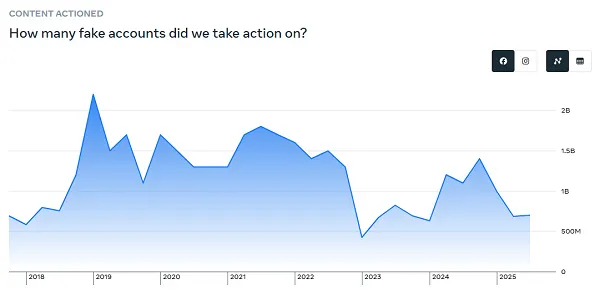
Meta says that its shift to a Neighborhood Notes mannequin is working, primarily based on its newest Neighborhood Requirements Enforcement Report replace, which gives perception into its efforts to average content material, and handle dangerous parts throughout its apps.
As you little question recall, again in January, Meta introduced that it could be shifting to a Neighborhood Notes mannequin, following the lead of X, whereas additionally ending its third-party fact-checking course of. The thought behind this, in keeping with Meta CEO Mark Zuckerberg, was that Meta had reached some extent the place it was censoring an excessive amount of, so it needed to provide customers extra enter into content material choices, versus making heavy-handed choices from on excessive.
The truth that this strategy aligns with what U.S. President Donald Trump would favor was fully coincidental and had nothing to do with Meta’s strategy on this entrance.
So how is Meta measuring the success of its Neighborhood Notes initiative within the U.S.?
As per Meta:
“Of the a whole lot of billions of items of content material produced on Fb and Instagram in Q3 globally, lower than 1% was eliminated for violating our insurance policies and fewer than 0.1% was eliminated incorrectly. For the content material that was eliminated, we measured our enforcement precision – that’s, the proportion of appropriate removals out of all removals – to be greater than 90% on Fb and greater than 87% on Instagram.”
So Meta says that it’s making fewer errors, and due to this fact fewer persons are complaining about Meta’s automated system eradicating their posts incorrectly.
Which Meta says is a win, however on the similar time, in case you’re eradicating extra content material general, after all there’s going to be fewer errors. And whereas Meta’s saying that “enforcement precision” was at 90%, it’s exhausting to quantify the success of Neighborhood Notes, as an alternative choice to systematic enforcement, if the one measure is consumer complaints, or not.
By way of particular coverage areas, Meta says that:
“On each Fb and Instagram, prevalence elevated for grownup nudity and sexual exercise, and for violent and graphic content material, and on Fb it elevated for bullying and harassment. That is largely attributable to modifications made throughout the quarter to enhance reviewer coaching and improve evaluation workflows, which impacts how samples are labeled when measuring prevalence.”
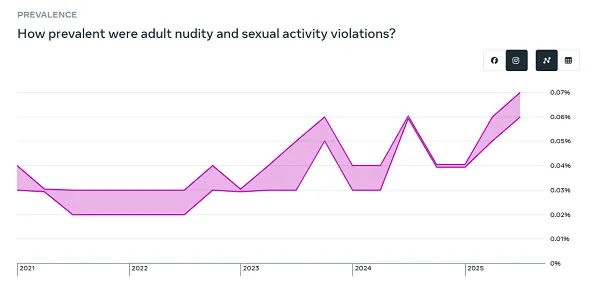
Given this proviso, it’s exhausting to say whether or not it is a important level of notice or not, as a result of Meta’s saying that the rise is barely attributable to a change in methodology.
So perhaps these spikes are price noting, perhaps they’re really indicators of enchancment.
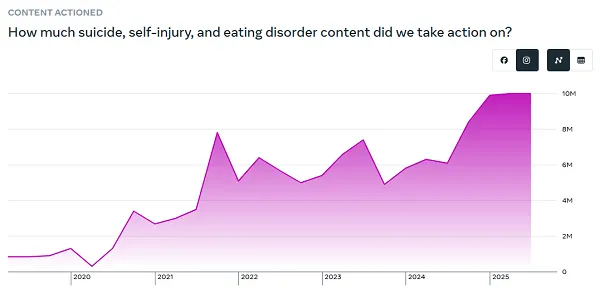
Although in gentle of the current push to extend social media restrictions amongst younger teenagers, this chart stays a priority:
By way of pretend accounts, Meta maintains that round 4% of its greater than 3 billion month-to-month lively customers are fakes.
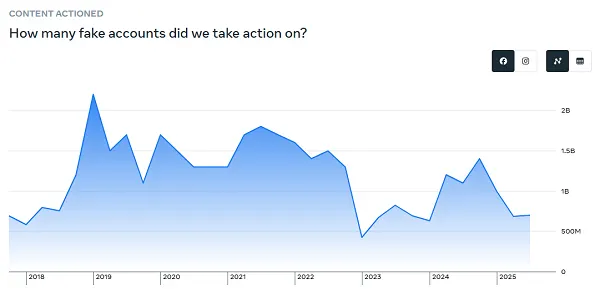
Many have questioned this, primarily based on their very own experiences of faux profiles on Fb and IG. Although today, it’s exhausting to inform what’s a pretend profile, and what’s AI, and whether or not each are thought-about to be the identical factor? I imply, Meta has been engaged on a undertaking so as to add in AI profiles to its apps, which can work together like actual individuals. So are these fakes?
Both manner, for context, 4% of three.54 billion complete customers nonetheless equates to greater than 140 million pretend profiles in its apps, which Meta is formally acknowledging.
So there’s that.
Meta has additionally revealed an replace to its “Extensively Considered Content material Report,” which gives extra context round what persons are really seeing on Fb within the U.S.
The report was initially launched again in 2021, with a purpose to dispel the notion that Fb’s algorithms amplify divisive content material and misinformation. By exhibiting what forms of posts and Pages really see essentially the most engagement, Meta’s searching for to focus on that it’s not as large of an issue on this respect as individuals would possibly understand, although once more, I’d notice that at Meta’s scale, even content material that will get comparatively small traction continues to be reaching doubtlessly hundreds of thousands of individuals.
However when it comes to what’s getting essentially the most attain, Meta studies that it’s largely trending information tales that Fb customers are most eager about.
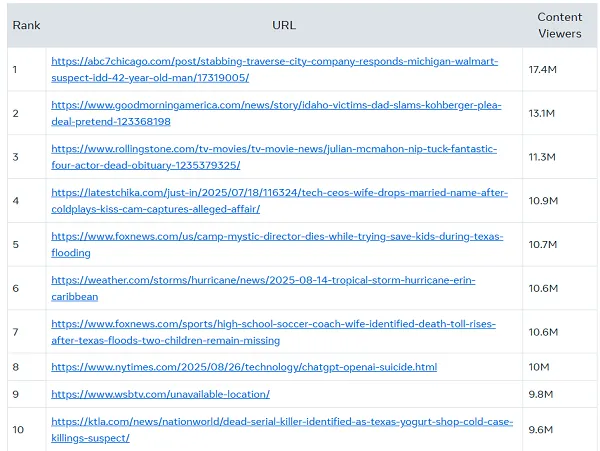
Crime tales, the demise of actor Julian McMahon, the Coldplay live performance couple, these are the forms of updates that gained essentially the most traction on Fb in Q3.
So it’s not politically divisive stuff, it’s intriguing tales of real-life occasions. Which is definitely higher than the same old content material that populates this record (usually, tabloid gossip wins out), however the backside line that Fb needs to place ahead is that political content material just isn’t a serious component of dialogue within the app.
Although, general, it’s price noting that the share of consideration for prime posts is miniscule at Fb’s scale.
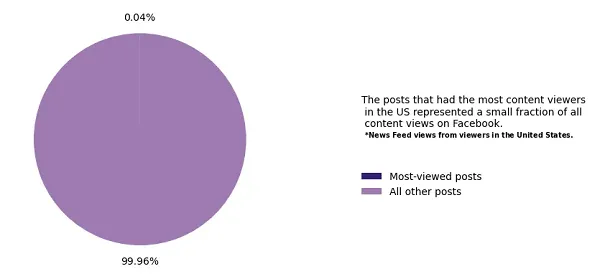
In broader context, the platform’s scale and attain is so large that any amplification is critical, so even with these notes on essentially the most shared posts, we’re not likely getting a lot of an understanding of Fb’s general affect on this respect.
Oh, there’s additionally this chart, which digital entrepreneurs hate:
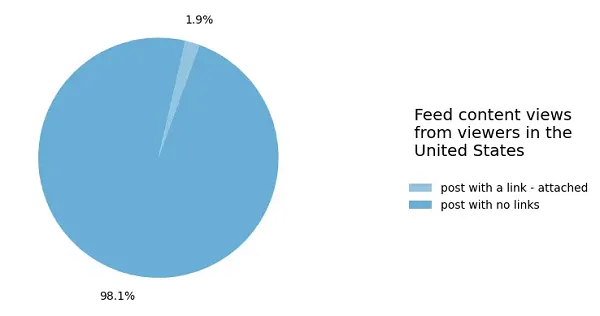
Hyperlink posts are a tiny, tiny a part of Fb general, so in case you’re seeking to drive site visitors, you’re prone to be dissatisfied.
The prevalence of hyperlink posts has decreased from Q1, when it was at 2.7%, whereas again in 2022, it was at 9.8%.
So a major decline for hyperlink posts within the app.
General, there’s no main standout findings in Meta’s newest transparency studies, with its efforts to evolve moderation resulting in fewer errors, however doubtlessly extra publicity to hurt consequently. Although in Meta’s metrics, it’s doing higher on this entrance as properly.
Andrew Hutchinson