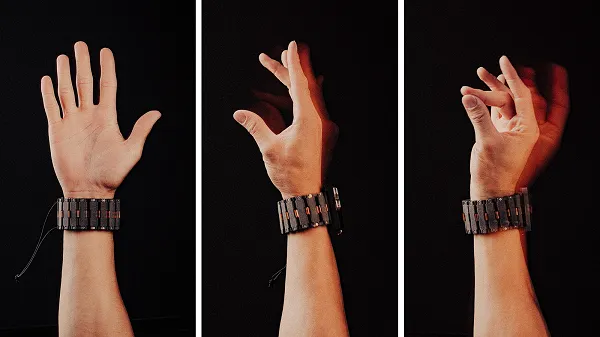
Meta’s supplied a glimpse into the way forward for digital interplay, through wrist-detected management, which is prone to kind a key a part of its coming AR and VR expansions.
Meta’s been engaged on a wrist controller, which depends on differential electromyography (EMG) to detect muscle motion, then translate that into digital indicators, for a while, and now, it’s revealed a new analysis paper in Nature which outlines its newest development on this entrance.
Which may very well be the muse of the subsequent stage.
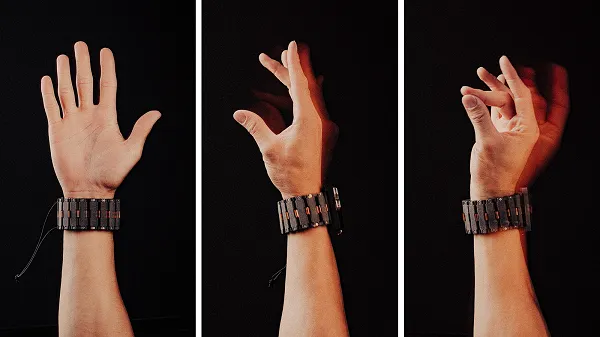
As defined by Meta:
“Our groups have developed superior machine studying fashions which are in a position to remodel neural indicators controlling muscle mass on the wrist into instructions that drive individuals’s interactions with [AR] glasses, eliminating the necessity for conventional – and extra cumbersome – types of enter.”
These “extra cumbersome” strategies embody keyboards, mice and touchscreens, the present principal types of digital interplay, which Meta says might be limiting, “particularly in on-the-go situations.” Gesture-based methods that use cameras or inertial sensors may also be restrictive, because of the potential for disruptions inside their area of view, whereas “mind–pc or neuromotor” interfaces that may be enabled through sensors detecting mind exercise are additionally typically invasive, or require large-scale, complicated methods to activate.
EMG management requires little disruption, and aligns together with your physique’s pure motion and behaviors in a delicate approach.
Which is why Meta’s now trying to incorporate this into its AR system.
“You’ll be able to kind and ship messages with out a keyboard, navigate a menu with out a mouse, and see the world round you as you interact with digital content material with out having to look down at your telephone.”
Meta says that its newest EMG controller acknowledges your intent to carry out quite a lot of gestures, “like tapping, swiping, and pinching – all together with your hand resting comfortably at your facet.”
The gadget may acknowledge handwriting exercise, to translate direct textual content.
And its newest mannequin has produced stable outcomes:
“The sEMG decoding fashions carried out effectively throughout individuals with out person-specific coaching or calibration. In open-loop (offline) analysis, our sEMG-RD platform achieved higher than 90% classification accuracy for held-out individuals in handwriting and gesture detection, and an error of lower than 13° s−1 error on wrist angle velocity decoding […] To our information, that is the best degree of cross-participant efficiency achieved by a neuromotor interface.”
To be clear, Meta continues to be growing its AR glasses, and there’s no concrete data on precisely how the controls for such will work. However it more and more looks as if a wrist-based controller will probably be part of the package deal, when Meta does transfer to the subsequent stage of its AR glasses mission.
The present plan is for Meta to start promoting its AR glasses to customers in 2027, when it’s assured that it is going to be in a position to create wearable, modern AR glasses for an inexpensive worth.
And with wrist management enabled, that would change the best way that we work together with the digital world, and spark a complete new age of on-line engagement.
Certainly, Meta CEO Mark Zuckerberg has repeatedly famous that good glasses will ultimately overtake smartphones as the important thing interactive floor.
So get able to hold a watch out for recording lights on individuals’s glasses, as their hand twitches at their facet, as a result of that, more and more appears to be like to be the place we’re headed with the subsequent stage of wearable improvement.
Andrew Hutchinson