This may seem to be a minor case, and one other instance of EU overreach in policing social media platforms. However a discovering late final week by a Dutch courtroom that Meta has to supply extra simply accessible non-algorithmic feed choices might have massive implications, and can change into an even bigger focus level for regulators shifting ahead.
Final Thursday, a Dutch courtroom dominated that Meta has to supply Fb and Instagram customers with extra simply accessible choices for non-algorithm-defined timelines, in keeping with laws outlined within the EU Digital Providers Act (DSA).
The case, which was introduced by digital rights group “Bits of Freedom,” claims that Meta is at present performing in violation of Article 27 of the DSA, which states that:
“Suppliers of on-line platforms that use recommender programs shall set out of their phrases and circumstances, in plain and intelligible language, the primary parameters used of their recommender programs, in addition to any choices for the recipients of the service to change or affect these important parameters […] The place a number of choices can be found for recommender programs that decide the relative order of knowledge offered to recipients of the service, suppliers of on-line platforms shall additionally make accessible a performance that permits the recipient of the service to pick out and to change at any time their most well-liked possibility.”
So below the DSA, Meta, and all massive social platforms, have to share perception into how their algorithmic amplification works, and in addition enable customers to replace their preferences to change their in-app expertise.
However extra particular to this case, the DSA additionally notes that:
“That [selection and modification] performance shall be straight and simply accessible from the precise part of the web platform’s on-line interface the place the knowledge is being prioritized.”
In different phrases, the choice to change what you’re being proven in every app must be “straight and simply accessible” from the feed that’s being outlined by any such algorithm.
To be clear, Meta does provide choices to pick out a chronological timeline in each apps, which it added again in 2022 on response to regulatory considerations about person alternative (in varied areas)
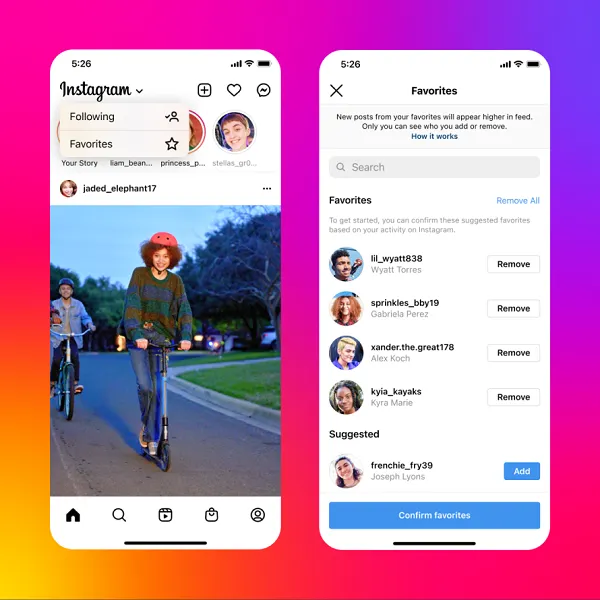
So you are able to do this, however you possibly can’t set your choice because the default, and Meta is aware of that most individuals received’t hassle to vary it.
Which Bits of Freedom says works in Meta’s profit:
“Meta has an curiosity in steering customers towards a feed the place it could possibly present as many curiosity‑ and conduct‑primarily based adverts as attainable. That’s the core of Meta’s income mannequin. Delicate design strategies push customers towards that feed, whereas the non‑profiled feed is hidden behind a emblem, making it laborious to seek out. Customers who do select the choice timeline additionally lose direct entry to options akin to Direct Messages. Furthermore, if you open the app, it at all times begins with Meta’s feed, even when the person chosen a unique one earlier than. Due to the choose’s ruling, Meta should change its conduct.”
So now, if this ruling is upheld (Meta has stated that it’s going to enchantment), Meta could also be pressured to permit individuals to decide out of its algorithmic timeline fully, which might revert customers to a purely chronological feed in every app, and set that because the default.
Which Meta itself doesn’t wish to occur, and doesn’t suppose will result in a greater person expertise.
Late final 12 months, Instagram chief Adam Mosseri defined that non-algorithm feeds don’t work anymore, regardless of individuals considering that they need this, with the utilization information they’ve discovered from experimenting with such truly displaying the other.
As per Mosseri:
“We’ve examined [non-algorithm feeds] and tried it a lot of occasions. Each time now we have, there’s a sub-group of people who find themselves joyful, there’s a bunch of people that neglect that they’re in it, after which general, all people who’s in it makes use of Instagram much less and fewer over time. And after we ask them questions like “how glad are you with Instagram?”, they really report being much less proud of Instagram an increasing number of over time, on common. After which there’s these second-order results the place their buddies begin utilizing Instagram much less [and] as a result of they use it much less, they ship much less likes and feedback, messages, after which there’s all of this different stuff, and it simply will get worse and worse, and rapidly.”
So Meta, in fact, needs to maximise engagement, and preserve individuals in its apps for longer, whereas additionally gathering useful response indicators from such. Algorithm-defined feeds higher facilitate this, so from a enterprise, and in line with Mosseri, a person satisfaction perspective, algorithm feeds are simply higher, and Meta doesn’t wish to give individuals a straightforward opt-out.
However algorithms have additionally been recognized as a key reason behind angst and division, with the inducement of algorithms being, primarily, engagement above all else.
And what drives engagement? Emotional response, and with the strongest drivers of emotional response being worry, anger and pleasure, you possibly can see how algorithmic amplification can gas the fires that result in better dispute and opposition, primarily based solely on these engagement triggers as information factors.
That was the case put ahead by Frances Haugen, a former Fb staffer turned whistleblower, who sparked varied regulatory investigations into the corporate on account of her perception into its operational strategy, and lack of concern inside such for person impacts.
Haugen’s important competition was that the elimination of engagement-based rating would assist to scale back division brought on by social media apps, by limiting the quantity of rage-baiting posts which are offered to the thousands and thousands of individuals utilizing them day-after-day. That will additionally scale back the inducement for publishers to supply such content material as a way to get consideration, and thus, affect the broader information ecosystem in the direction of extra measured, balanced reporting.
And there’s some logic to that. It wouldn’t eradicate the motivation behind such fully (as customers would nonetheless have the ability to share posts, amplifying them both means). However by lowering the drivers that incentivize angst and division, that looks like a logical evolution that goals to handle such considerations.
However it could affect the income alternatives of social apps, as utilization would inevitable decline, as famous by Mosseri. However possibly that’s price it, and possibly, if this Dutch choice is upheld, we might truly get our first actual have a look at the impacts of such at scale, if Meta is certainly pressured to implement non-algorithmic feeds as a default in sure markets.
It probably is price a larger-scale experiment, however Meta is actually not going to volunteer for such.
The Dutch courtroom has dominated that Meta has two weeks to supply customers a “direct and easy” option to decide out of a timeline with beneficial content material (once more, Meta is interesting the decision).
Andrew Hutchinson