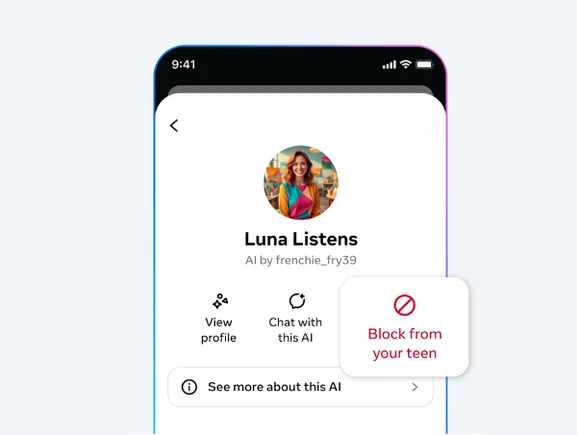
Meta’s banning teen entry to its AI chatbots in several personas, because it appears to implement a brand new system that can guarantee extra security of their utilization, and handle considerations about teenagers getting dangerous recommendation from these choices.
Which is smart, given the considerations already raised round AI bot interplay, however actually, these would apply to everybody, not simply teen customers.
Again in October, Meta rolled out some new choices for fogeys to regulate how their youngsters work together with AI profiles in its apps, amid considerations that some AI chatbots had been offering probably dangerous recommendation and steering to teenagers.
Certainly, a number of AI chatbots had been discovered to be giving teenagers harmful steering on self-harm, disordered consuming, the right way to purchase medicine (and conceal it out of your dad and mom), and many others.
That sparked the launch of an FTC investigation into the potential dangers of AI chatbot interplay, and in response to that, Meta added extra management choices that might allow dad and mom to restrict how their youngsters have interaction with its AI chatbots, with the intention to mitigate the potential concern.
To be clear, Meta’s not alone on this. Snapchat has additionally needed to change the principles round the usage of its “My AI” chatbot as properly, whereas X has had its personal current large-scale points with folks utilizing its Grok chatbot to generate offensive photos.
Generative AI remains to be in its infancy, and as such, it’s just about inconceivable for builders to counter for each potential misuse. Besides, these makes use of by teenagers appear fairly simple to foretell, which probably displays the broader push for speedy improvement over danger.
In any occasion, Meta’s implementing new controls over its AI bots to handle this concern. However because it does so, it’s now determined to quickly reduce off teen entry to its AI chatbots completely (besides Meta AI).
As per Meta:
“In October, we shared that we’re constructing new instruments to provide dad and mom extra visibility into how their teenagers use AI, and extra management over the AI characters they will work together with. Since then, we’ve began constructing a brand new model of AI characters, to provide folks an excellent higher expertise. Whereas we deal with growing this new model, we’re quickly pausing teenagers’ entry to current AI characters globally.”
I imply, that doesn’t sound nice. It appears like extra considerations have been raised, whereas clearly, the FTC probe could be taking part in on the minds of Meta execs, as a possible penalty looms over any and all misuse.
“Beginning within the coming weeks, teenagers will not be capable of entry AI characters throughout our apps till the up to date expertise is prepared. This may apply to anybody who has given us a teen birthday, in addition to individuals who declare to be adults however who we suspect are teenagers based mostly on our age prediction expertise. Because of this, once we ship on our promise to provide dad and mom extra oversight of their teenagers’ AI experiences, these parental controls will apply to the most recent model of AI characters.”
So Meta’s tacitly admitting that there are some important flaws in its AI chatbots, which should be addressed. And whereas teenagers will nonetheless be capable of entry its principal Meta AI chatbot, they gained’t be capable of work together with customized bot personas inside its apps.
Will which have a huge impact?
Nicely, a research printed final July discovered that 72% of U.S. teenagers have already used an AI companion, with a lot of them now conducting common social interactions with their chosen digital associates.
Mix this with Meta’s push to introduce a military of AI chatbot personas into its apps, as a way to spice up engagement, and it most likely does put a spanner within the works for its broader plans.
However the greatest query is how one can probably safeguard AI interplay of this sort, provided that AI bots are studying from the web, and can modify their responses based mostly on the question.
There are numerous methods to trick AI chatbots into supplying you with responses that their builders would like they don’t present, however as a result of they’re matching up language on such a big scale, it’s inconceivable to account for each variation on this respect.
And digital native teenagers are extraordinarily savvy, and will likely be searching for weak factors in these programs.
As such, the transfer to limit entry completely is smart, however I’m undecided how Meta will be capable of develop efficient safeguards in opposition to future considerations.
So perhaps simply don’t implement AI chatbots in several personas that current themselves as actual folks.
There’s no actual want for them in any context, and so they additionally arguably run counter to the “social” side of social media anyway, because it’s not “social,” in our extra widespread understanding of the time period, to speak to a pc.
Social media was designed to facilitate human interplay, and the push to dilute that with AI bots appears at odds with this. I imply, I get why Meta would need to do it, as extra AI bots participating like actual folks in its apps, liking posts, leaving feedback, all of this stuff will make actual human customers really feel particular, and can encourage extra posting conduct, and time spent.
I do know why Meta would need to implement such, however I don’t assume the dangers of such have been totally assessed, particularly when you think about the potential impacts of growing relationships with non-human entities, and what that may do for folks’s notion and psychological state.
Meta’s admitting that this may be an issue in teenagers. However actually, it might be an issue throughout the board, and I don’t consider that the worth of those bots, from a person perspective, would outweigh that potential danger.
At the least till we all know extra. At the least till we’ve obtained some large-scale research that present the impacts of AI bot interplay, and whether or not it’s a very good or unhealthy factor for folks.
So why cease at banning them for teenagers, why not ban them for everybody till we have now extra perception?
I do know this gained’t occur, however this looks like an admission that this can be a extra important space of concern than Meta anticipated.
Andrew Hutchinson