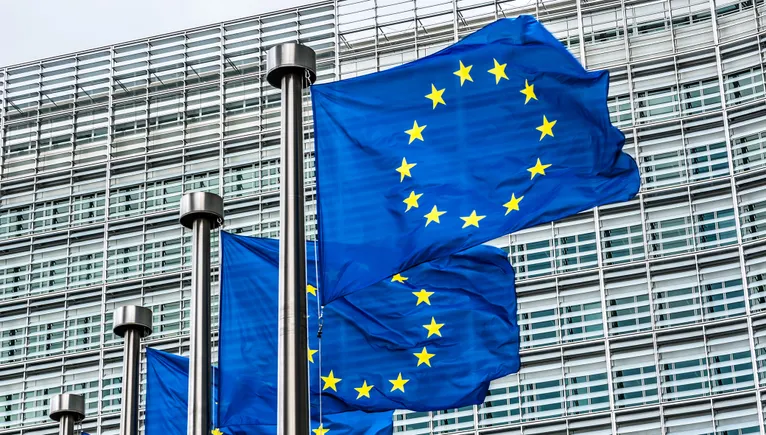
It seems like we’re headed for a major diplomatic battle over EUs ongoing penalties being issued to American-owned social platforms, because the Trump administration continues to share its dissatisfaction with EU laws, and social platforms proceed to be hit with main penalties.
And people hits simply carry on coming, with Meta this week issued an official warning from EU officers over its insurance policies which block the usage of rival synthetic intelligence assistants on WhatsApp, which is probably in violation of EU guidelines round competitors and market equity.
As per the EU Fee: “The European Fee has despatched a Assertion of Objections to Meta, setting out its preliminary view that Meta breached EU antitrust guidelines by excluding third-party Synthetic Intelligence (‘AI’) assistants from accessing and interacting with customers on WhatsApp. Meta’s conduct dangers blocking opponents from coming into or increasing within the quickly rising marketplace for AI assistants.”
The Fee says that on Oct. 15 final yr, Meta introduced an replace to its WhatsApp Enterprise Resolution phrases, which successfully bans third-party general-purpose AI assistants from the appliance. “In consequence, since 15 January 2026, the one AI assistant accessible on WhatsApp is Meta’s personal software, Meta AI, whereas opponents have been excluded.”
That’s in breach of EU guidelines round competitors, as it’ll considerably restrict the capability of third-party AI suppliers to enter the market, given Meta’s dominant place. As such, Meta is being requested to permit these third-party instruments inside its app, and to drop this regulation totally.
The Fee says that it’s going to impose interim measures to forestall Meta’s strategy from harming the native market, whereas it waits for Meta’s response on the matter.
Is that truthful?
It’s troublesome to say, as a result of whereas Meta would logically have little interest in serving to its opponents acquire any traction within the EU market, there’s an argument to be made that Meta’s dominant place will stifle all competitors if it’s allowed to implement such measures.
However however, the EU Fee has an ongoing historical past of expansive guidelines that dictate what social media corporations can and may’t do, in relation to knowledge gathering, advert focusing on, moderation, censorship, and so on. There are such a lot of guidelines, that are continuously altering, that it’s nearly unattainable for social platforms to maintain up, and a minimum of a few of these guidelines do appear designed to extract cash from U.S.-based tech giants, versus defending the rights of EU residents.
Which isn’t unusual. Most nations have a minimum of tried to implement taxes and penalties to be able to pressure social media platforms to pay extra into their native financial system, with some searching for to, say, cost platforms for utilizing native writer content material, below questionable provisions.
The principle impetus appears to be that these social media platforms have grow to be so dominant, and so influential, that they’ve impacted the native financial system, and specifically, the native digital advertisements market, and subsequently, native suppliers have pushed for politicians to make them pay, in some way, to be able to offset losses.
These penalties have come in numerous types, and most of these purposes are justifiable, a minimum of from some perspective. Nevertheless it does really feel like a minimum of a few of these pushes are simply straight up money grabs, searching for to restrict the amount of cash that American social media giants can extract from their native financial system.
On this respect, many of those might be countered by improved taxation, and guaranteeing that corporations working inside a nation are being taxed on the proper fee. Meta, like most main companies, will search to reduce its tax burden the place doable by basing its regional places of work in close by tax havens, however in some instances, native governments might push to have Meta taxed below their guidelines, which might see extra shared again into the native financial system.
Although that comes with its personal issues, whereas it’s additionally a vote-winner for politicians to come back out and say that they’re making social media suppliers pay for particular ills, as a result of notion of hurt by social media apps.
I don’t faux to know the complexities of every particular scenario in every area, but it surely does appear to be a minimum of a number of the laws which are pressured onto Meta, and different social media suppliers, are motivated by cash greater than security.
And in some instances, the Trump workforce views issues the identical approach, with varied Trump administration officers criticizing overseas penalties for social media apps.
I imply, they appear extra doubtless to reply to penalties enacted on X, given Elon Musk’s shut relationship with the Trump workforce. However Meta has additionally been cozying as much as Trump nonetheless it could, to be able to acquire extra helpful therapy, and probably, extra high-powered help for its push again in opposition to overseas penalties.
The EU Fee can be the prime goal on this respect, and with Meta dealing with yet one more main tremendous, it does appear to be the U.S. authorities can be known as upon to oppose such, and probably threaten retaliatory commerce measures in response.
Meta is presently being fined over $1 billion {dollars} per yr in Europe on common, whereas X can be dealing with new penalties over its current Grok controversies.
Will that result in an even bigger diplomatic battle in future?
Andrew Hutchinson