
I notice that it is a controversial consideration, for a lot of causes, and that it’ll probably by no means acquire traction, and perhaps it shouldn’t. However perhaps there are advantages to implementing extra stringent controls over social media algorithms, and limitations on what can and might’t be boosted by them, so as to tackle the fixed amplification of rage-baiting, which is clearly inflicting large divides in Western society.
The U.S., in fact, is the prime instance of this, with extremist social media personalities now driving large divides in society. Such commentators are successfully incentivized by algorithmic distribution; Social media algorithms intention to drive extra engagement, so as to maintain folks utilizing their respective apps extra usually, and the most important drivers of engagement are posts that spark robust emotional response.
Varied research have proven that the feelings that drive the strongest response, notably when it comes to social media feedback, are anger, worry and pleasure. Although of the three, anger has probably the most viral potential.
“Anger is extra contagious than pleasure, indicating that it may drive extra offended follow-up tweets and anger prefers weaker ties than pleasure for the dissemination in social community, indicating that it may penetrate completely different communities and break native traps by extra sharing between strangers.”
So anger is extra more likely to unfold to different communities, which is why algorithmic incentive is such a significant concern on this respect, as a result of algorithmic equations, which aren’t capable of think about human emotion, will amplify no matter’s driving the most important response, and present that to extra customers. The system doesn’t know what it’s boosting, all it’s assessing is response, with the binary logic being that if lots of people are speaking about this topic/challenge/put up, then perhaps extra folks shall be concerned about seeing the identical, and including their very own ideas as nicely.
This can be a main challenge with the present digital media panorama, that algorithmic amplification, by design, drives extra angst and division, as a result of that’s inadvertently what it’s designed to do. And whereas social platforms are actually attempting so as to add in a stage of human enter into this course of, in approaches like Group Notes, which append human-curated contextual tips to such traits, that gained’t do something to counter the mass-amplification of divisive content material, which once more, creators and publishers are incentivized to create so as to maximize attain and response.
There’s no method to tackle such inside purely performance-driven algorithmic techniques. However what if the algorithms had been designed to particularly amplify extra optimistic content material, and cut back the attain of much less socially helpful materials?
That’s already taking place in China, with the Chinese language authorities implementing a stage of management over the algorithms in standard native apps, so as to make sure that extra optimistic content material is amplified for extra folks.
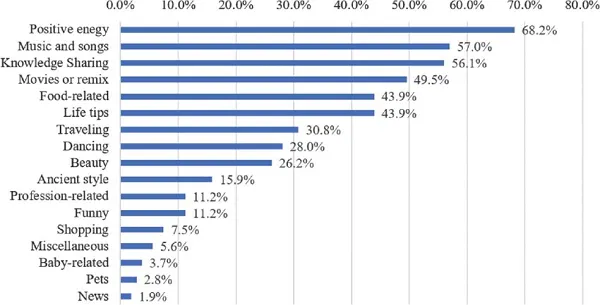
As you may see on this itemizing of the matters that see the best price of promotion on Douyin, which is the Chinese language native model of TikTok, among the many hottest matters are ‘optimistic power’ and ‘information sharing,’ two matters that will be unlikely to get wherever close to these ranges of comparative engagement on TikTok.
That’s as a result of the Chinese language authorities seeks to handle what younger individuals are uncovered to in social apps, with the concept being that by selling extra optimistic traits, that’ll encourage the youth to aspire to extra helpful, socially helpful parts.
Versus TikTok, wherein prank movies, and more and more, content material selling political discourse, are the norm. And with an increasing number of folks now getting their information inputs from TikTok, particularly youthful audiences, that signifies that the divisive nature of algorithmic amplification is already impacting children, and their views on how the world works. Or extra operatively, the way it doesn’t below the present system.
Some have even advised that that is the primary intention of TikTok, that the Chinese language authorities is searching for to make use of TikTok to additional destabilize Western society, by seeding anti-social behaviors through TikTok clips. That’s a little bit too conspiratorial for me, however it’s price noting the comparative division that such amplification conjures up, versus selling extra helpful content material.
To be clear, I’m not arguing that Western governments must be ruling social media algorithms in the way in which that the CCP influences the traits in standard social apps in China. However there’s something to be stated for chaos versus cohesion, and the way social platform algorithms contribute to the confusion that drives such division, notably amongst youthful audiences.
So what’s the reply? Ought to the U.S. authorities look to, say, take possession of Instagram and assert its personal affect over what folks see?
Effectively, on condition that U.S. President Donald Trump remarked final week that he would make TikTok’s algorithm “100% MAGA” if he may, that’s in all probability lower than ultimate. However there does appear to be a case for extra management over what traits in social apps, and for weighting sure, extra optimistic actions extra closely, so as to improve understanding, versus undermining it.
The issue is there’s no arbitrator that anybody can belief to do that. Once more, should you belief the sitting authorities of the time to regulate such, then they’re more likely to angle these traits to their very own profit, whereas such an strategy would additionally require variable approaches in every area, which might be more and more troublesome to handle and belief.
You would look to let broad governing our bodies, just like the European Union, handle such on a broader scale, although EU regulators have already brought on vital disruption by way of their evolving huge tech laws, for questionable profit. Would they be any higher at managing optimistic and adverse traits in social apps?
And naturally, all of that is implementing a stage of bias, which many individuals have been opposing for years. Elon Musk ostensibly bought Twitter for this precise purpose, to cease the Liberal bias in social media apps. And whereas he’s since tilted the steadiness the opposite approach, the Twitter/X instance is a transparent demonstration of how non-public possession can’t be trusted to get this proper, somehow.
So how do you repair it? Clearly, there’s a stage of division inside Western society which is resulting in main adverse repercussions, and a whole lot of that’s being pushed by the continued demonization of teams of individuals on-line.
For instance of this in observe, I’m certain that everyone is aware of at the very least one one who posts about their dislike for minority teams on-line, but that very same individual in all probability additionally is aware of folks of their actual life who’re a part of those self same teams that they vilify, they usually don’t have any drawback with them in any respect.
That disconnect is the problem, that who individuals are in actual life just isn’t who they painting on-line, and that broad generalization on this approach just isn’t indicative of the particular human expertise. But algorithmic incentives push folks to be any person else, pushed by the dopamine hits that they get from likes and feedback, inflaming sore spots of division for the good thing about the platforms themselves.
Perhaps, then, algorithms be eradicated solely. That may very well be a partial answer, although the identical emotional incentives additionally drive sharing behaviors. So whereas eradicating algorithmic amplification may cut back the ability of engagement-driven techniques, folks would nonetheless be incentivized, to a lesser diploma, to spice up extra emotionally-charged narratives and views.
You’ll nonetheless, for instance, see folks sharing clips from Alex Jones wherein he intentionally says controversial issues. However perhaps, with out the algorithmic boosting of such, that will have an effect.
Individuals as of late are additionally way more technically savvy total, and would be capable of navigate on-line areas with out algorithmic helps. However then once more, platforms like TikTok, that are solely pushed by indicators which can be outlined by your viewing habits, have modified the paradigm for the way social platforms work, with customers now way more attuned to letting the system present them what they need to see, versus having to hunt it out for themselves.
Eradicating algorithms would additionally see the platforms undergo large drops in engagement, and thus, advert income because of this. Which may very well be a much bigger challenge when it comes to limiting commerce, and social platforms now even have their very own armies of lobbyists in Washington to oppose any such proposal.
So if social platforms, or some greater arbitrator, can’t intrude, and downgrade sure matters, whereas boosting others, within the mould of the CCP strategy, there doesn’t appear to be a solution. Which signifies that the heightened sense of emotional response to each challenge that comes up is about to drive social discourse into the longer term.
That in all probability signifies that the present state of division is the norm, as a result of with a common public that more and more depends on social media to maintain it knowledgeable, they’re additionally going to maintain being manipulated by such, based mostly on the foundational algorithmic incentives.
With out a stage of intervention, there’s no approach round this, and given the opposition to even the suggestion of such interference, in addition to the dearth of solutions on the way it is perhaps utilized, you may count on to maintain being angered by the newest information.
As a result of that emotion that you simply really feel if you learn every headline and scorching take is the entire level.
Andrew Hutchinson